Thursday, 11 December 2025

Taj Mahal History

TAJ MAHAL
 

Taj Mahal

The Taj Mahal, located on the right bank of the Yamuna River in Agra, Uttar Pradesh, stands as one of the world’s most celebrated symbols of love. Mughal Emperor **Shah Jahan** commissioned this iconic mausoleum in memory of his beloved wife **Mumtaz Mahal**, who passed away in 1631. Construction began in 1632 and continued for more than two decades, completed around 1653. Over 20,000 skilled artisans—including masons, calligraphers, stone-cutters, and craftsmen from India, Persia, Central Asia, and Iran—were brought together for this monumental project. The chief architect is believed to have been **Ustad Ahmad Lahori.

Taj Mahal


 Spread across nearly 17 hectares, the Taj Mahal complex includes the main tomb, a mosque, a guest house, the grand southern gateway, and a beautifully planned Mughal garden. The tomb, made of shining white marble inlaid with precious and semi-precious stones, blends Indian, Persian, and Islamic architectural styles. The central chamber houses the symbolic cenotaphs of Mumtaz Mahal and Shah Jahan, while their actual graves lie in the lower crypt. The delicate marble lattice screen enclosing the cenotaphs showcases extraordinary craftsmanship, with floral patterns so detailed they appear almost real.


Taj Mahal

A defining characteristic of the Taj Mahal is its perfect symmetry. The main building rests on a raised marble platform, with four slender minarets standing at each corner, giving the monument a balanced and three-dimensional form. Another architectural innovation is the placement of the tomb at one end of the garden rather than the center, which creates a powerful perspective and adds depth to the overall view.

The complex also contains a mosque and a guest house, both built with red sandstone, offering a striking contrast to the white marble mausoleum. The main gateway, positioned at the southern edge, stands as a grand entrance to the serene garden divided into symmetrical quadrants following the traditional Persian-Timurid design.

Taj Mahal

 Recognized as a masterpiece of Indo-Islamic architecture, the Taj Mahal is celebrated for its harmony, balance, and artistic excellence. From the interplay of light and shadow on its domes and arches to the changing colors of the marble throughout the day, its beauty remains timeless.

additional environmental regulations within the **Taj Trapezium Zone**, a 10,400 sq km area created to safeguard it from industrial pollution. The Supreme Court has mandated the use of cleaner fuels in nearby industries to reduce environmental damage.

 Continued conservation, appropriate management, and sustainable tourism planning are essential to protect this UNESCO World Heritage Site. With proper care, the Taj Mahal will continue to inspire future generations as a symbol of enduring love, architectural brilliance, and cultural heritage.

 
Taj Mahal

Recognized as a masterpiece of Indo-Islamic architecture, the Taj Mahal is celebrated for its harmony, balance, and artistic excellence. From the interplay of light and shadow on its domes and arches to the changing colors of the marble throughout the day, its beauty remains timeless.

Thursday, 26 June 2025

BAPS Hindu Mandir, Abu Dhabi

 BAPS Hindu Mandir

BAPS Hindu Mandir

BAPS Hindu Mandir, Abu Dhabi: A Monument of Harmo

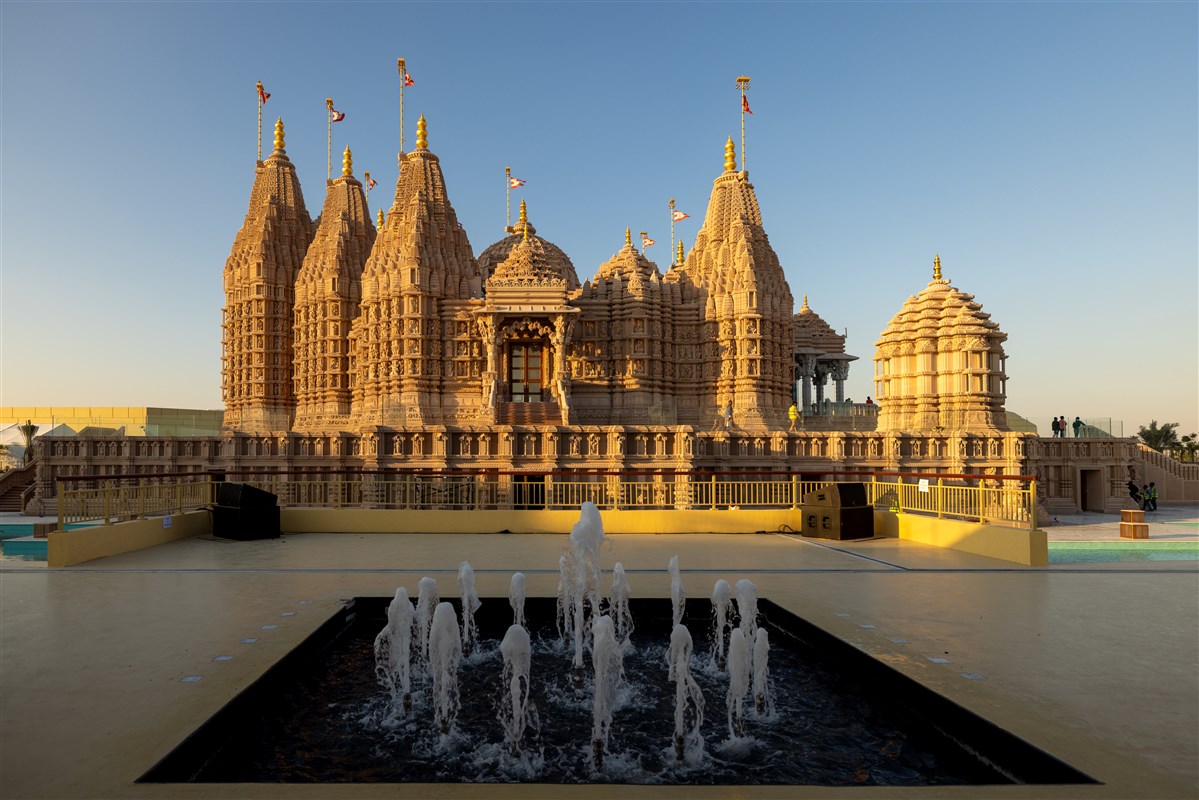
The BAPS Hindu Mny and Faithandir in Abu Dhabi, United Arab Emirates, stands as a remarkable testament to interfaith harmony and cultural collaboration. Conceived by Pramukh Swami Maharaj in 1997 and consecrated by Mahant Swami Maharaj on 14 February 2024, it is the first traditional Hindu stone temple in the Middle East.

BAPS Hindu Mandir
Origins and Vision

The idea of building a Hindu temple in the UAE emerged during Pramukh Swami Maharaj's visit to the region in 1997. His vision gained momentum in August 2015, when the UAE government announced it would provide land for the temple. Sheikh Mohammed bin Zayed Al Nahyan, then Crown Prince of Abu Dhabi, generously gifted 27 acres for this project. The land allocation was divided between the temple and its parking facilities.

BAPS Hindu Mandir
Construction and Architecture

Construction began in December 2019 after legal approval in September of the same year. The mandir is located in Abu Mureikhah, near the Dubai–Abu Dhabi Sheikh Zayed Highway. Made of pink sandstone from Rajasthan and Italian marble, it stands 108 feet tall, 262 feet long, and 180 feet wide. Notably, it's the first traditional Hindu mandir to undergo full digital modeling and seismic simulation, making it both historically significant and structurally advanced.

More than 2,000 artisans worked on the carvings, and over 200 international volunteers contributed around 690,000 hours to bring the vision to life. Sustainable practices such as using fly ash in concrete and recycling materials were integrated into the construction.

BAPS Hindu Mandir
Spiritual and Cultural Significance

The mandir houses seven main shrines, featuring deities such as:

  • Swaminarayan and Gunatitanand Swami (Akshar-Purushottam Maharaj)
  • Radha-Krishna
  • Rama, Sita, Lakshmana, and Hanuman
  • Shiva, Parvati, Ganesha, and Kartikeya
  • Venkateshwara and Padmavati
  • Jagannath, Balabhadra, and Subhadra
  • Ayyappan on a replica of Sabarimala’s 18 sacred steps

The temple also celebrates global stories and motifs, with carvings depicting not just Hindu epics but also tales from Arabian, Egyptian, Mesopotamian, and Native American civilizations. Animals symbolic of the UAE—like camels, oryxes, and falcons—are intricately carved into its structure.

BAPS Hindu Mandir
Symbol of Unity

Designed according to ancient Hindu scriptures (Shilpa Shastras), the temple's layout includes:

  • Two domes, seven spires (representing the seven Emirates)
  • 12 samrans, 402 intricately carved pillars
  • The Dome of Harmony, symbolizing the five elements of nature
  • Facilities like a visitor center, prayer halls, learning spaces, gardens, food court, gift shop, and sports areas for children

One unique feature is the Wall of Harmony, a 47-meter-long structure 3D-printed by the Dawoodi Bohra Muslim community, emphasizing interfaith collaboration.

BAPS Hindu Mandir
A Global Celebration

The inauguration was marked by a 12-day "Festival of Harmony" in February 2024. A global "Yagna for Harmony", interfaith assemblies, and cultural programs reflected the temple's broader mission. Indian Prime Minister Narendra Modi, Sheikh Nahyan bin Mubarak Al Nahyan, and Mahant Swami Maharaj participated in the dedication.

After opening to the public on 1 March 2024, the temple attracted over 65,000 visitors within the first weekend. A special bus route now connects Abu Dhabi city to the mandir to accommodate the steady stream of pilgrims and tourists.

BAPS Hindu Mandir
Legacy of Interfaith Harmony

The project reflects unprecedented cooperation among diverse faiths and cultures. From a Muslim king donating the land to contributions from Christian architects, Sikh managers, Buddhist engineers, and Jain directors, the mandir exemplifies unity in diversity. It has earned recognition globally as a powerful emblem of peace, coexistence, and shared spiritual values.


Taj Mahal History

TAJ MAHAL   The Taj Mahal, located on the right bank of the Yamuna River in Agra, Uttar Pradesh, stands as one of the world’s most celebrate...